
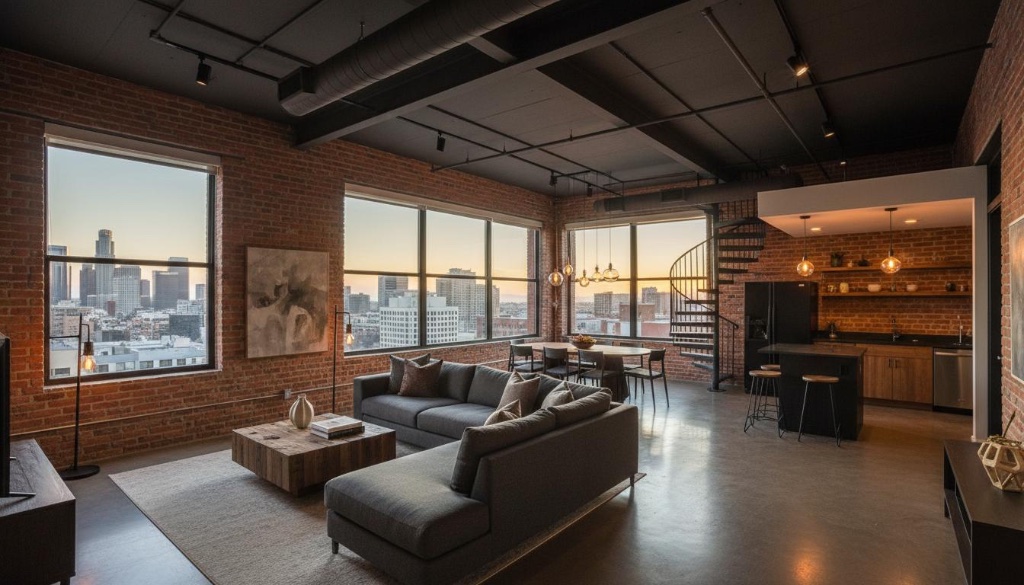
WHY CEILING HEIGHT CHANGES THE WAY AN LA LOFT LIVES
Our Blog
Ceiling height is one of those details people notice immediately in a loft, but do not always know how to evaluate. Everyone likes the drama of a tall room. The harder question is whether that height makes the home easier to live in, harder to furnish, more expensive to maintain, or more valuable when it is time to sell.
In Los Angeles loft buildings, especially older adaptive reuse buildings, ceiling height can change the entire feel of a unit. It affects light, sound, storage, temperature, furniture scale, bedroom privacy, and even how flexible the floor plan feels over time.
That does not mean taller is automatically better. It means ceiling height should be read as part of the whole space, not as a one-line brag in a listing description.
Tall ceilings create volume, not extra square footage
A loft with 14-foot ceilings can feel much larger than its measured square footage. That matters because many lofts are open plan. Without a traditional hallway, formal dining room, or closed bedrooms, the sense of volume becomes part of the value.
But volume is not the same as usable area. A 900-square-foot loft with high ceilings is still 900 square feet. You may feel more breathing room, more light, and more design flexibility, but you still need to solve the practical layout questions: where the bed goes, where the sofa goes, how work space is separated, and whether storage is adequate.
The best lofts use ceiling height to make the space more livable. The weaker ones use height as a distraction from awkward proportions, limited storage, poor window placement, or a floor plan that is hard to furnish.
Light behaves differently in a taller room
One of the real advantages of ceiling height is how it handles light. Tall windows can pull daylight deeper into the space. Clerestory windows, industrial sash windows, and double-height glazing can make a loft feel calm even when the footprint is compact.
Still, height alone does not guarantee good light. Window direction matters. So does the building across the street, the depth of the unit, the color of the floors, and whether the room has interior partitions that block the light path.
When touring a loft, look at where the light lands, not just how tall the windows are. A dramatic wall of glass that faces a dark courtyard may be less useful than a more modest window line with open exposure.
Furniture has to match the scale
High ceilings can make normal furniture look small. A low sofa, tiny rug, or undersized light fixture can feel lost in a large-volume room. That is why the most successful loft interiors usually have a few pieces with real scale: a larger rug, taller shelving, full-height curtains, a bigger pendant, or artwork that can hold the wall.
This is not about making the home feel expensive. It is about proportion. A loft with tall ceilings needs furniture that acknowledges the height without filling every inch of it.
Buyers should think about this before closing. If the space requires all-new furniture, custom window coverings, tall ladders, or specialized lighting, that should be part of the budget conversation.
Sound can travel more than expected
Open volume can be beautiful, but it can also be loud. Hard floors, exposed concrete, brick walls, steel windows, and high ceilings can make sound bounce. In some lofts, a phone call in the living area carries into the sleeping area. A television can echo. A dog, blender, or neighbor noise can feel sharper than expected.
This is manageable, but it should not be ignored. Rugs, fabric panels, drapery, upholstered furniture, bookshelves, and thoughtful layout can soften a loft dramatically. The key is knowing whether the acoustics are a minor design issue or a daily-life problem.
If you are sensitive to noise, spend a few quiet minutes in the unit during a showing. Listen after everyone stops talking. You will learn more in that pause than you will from the listing copy.
Heating and cooling are part of the math
A taller room means more air volume. Depending on the building, that can affect comfort and utility cost. Some lofts hold heat near the ceiling. Some are harder to cool near big west-facing windows. Some have older systems that were never designed for the way people now use live/work-style spaces.
Before buying, ask what type of heating and cooling system serves the unit, how old it is, whether there are maintenance records, and whether the HOA has rules around equipment changes. In a loft, comfort is not just about the thermostat. It is about the relationship between ceiling height, window exposure, insulation, and mechanical systems.
Lofts with mezzanines need extra attention
Some high-ceiling lofts add a mezzanine, sleeping platform, or partial second level. That can be useful, but it deserves careful review.
Ask whether the mezzanine is permitted, counted in square footage, reflected in tax records, and acceptable to the HOA. Check head clearance. Look at stair comfort. Think about privacy, ventilation, and how the upper area actually functions at night.
A mezzanine can make a loft far more practical. It can also be a clever-looking compromise that feels cramped after the novelty wears off.
For sellers, height should be marketed with context
If you are selling a loft with great ceiling height, the marketing should show more than a wide-angle room shot. It should help buyers understand how the space lives.
Show the window scale. Show the furniture plan. Show where the bedroom area sits. Show how the room handles work, entertaining, and storage. If there are custom improvements, lighting upgrades, built-ins, or a smart mezzanine, explain them plainly.
Buyers are not just buying tall walls. They are buying a way to live inside them.
The real question
Ceiling height is one of the reasons people fall in love with lofts. It gives the space character, openness, and a feeling that is hard to duplicate in a standard condo.
But the right question is not, “How high are the ceilings?”
The better question is, “What does that height do for the way this home lives?”
When the answer is better light, better proportion, better flexibility, and a stronger sense of place, ceiling height becomes more than a visual feature. It becomes part of the value.