
VIRTUAL STAGING IN REAL ESTATE: HELPFUL VISION OR MISLEADING MARKETING?
Our Blog
Virtual Staging in Real Estate: Helpful Vision or Misleading Marketing?
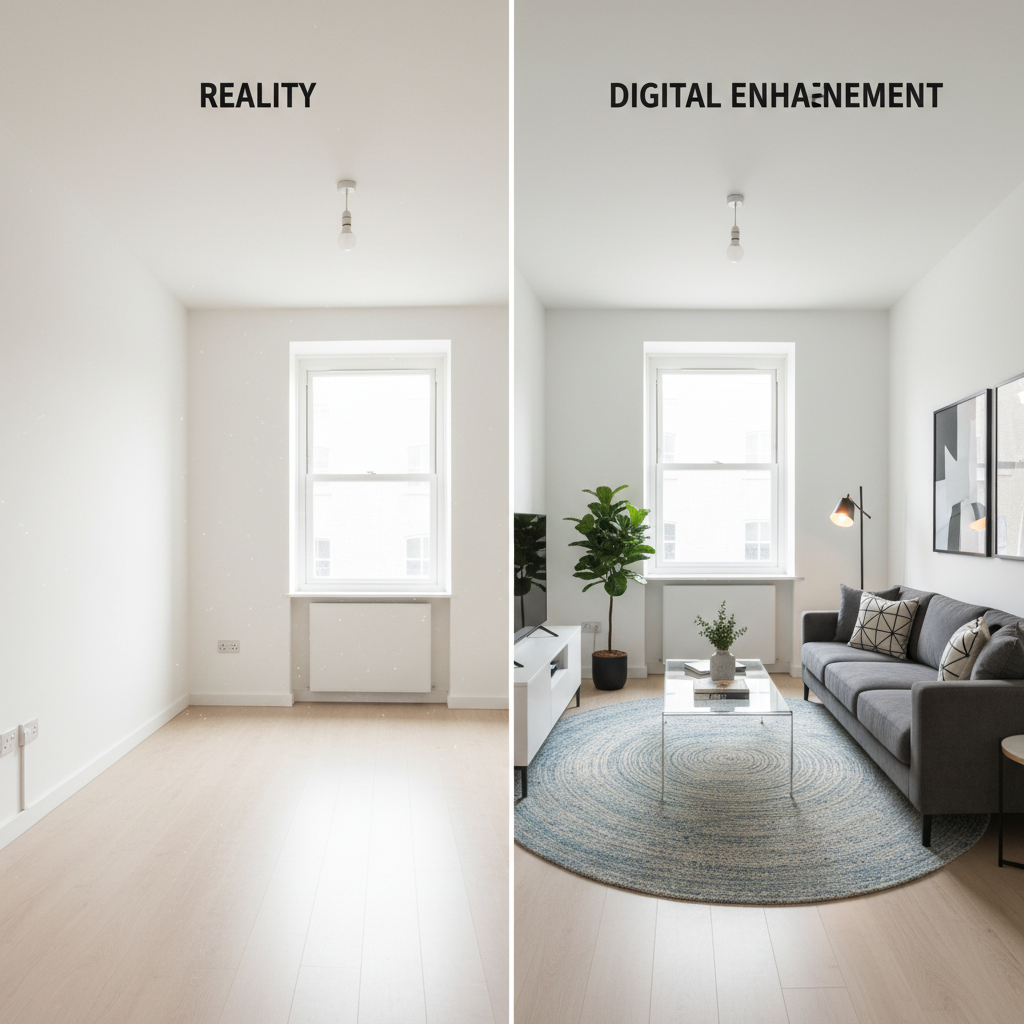
Walk into almost any listing feed today and you’ll see beautifully furnished living rooms, styled bedrooms, and home offices that look ready for a design magazine. Then you visit the property in person and realize the room is empty — or worse, the layout feels completely different than what you expected online.
That gap is exactly why virtual staging has become such a hot debate in real estate.
Some agents and sellers see virtual staging as a practical, modern tool that helps buyers imagine a home’s potential. Others see it as a line-crossing tactic that can create false expectations and waste everyone’s time. Both sides have a point. The real issue is not whether virtual staging exists. The real issue is how it is used.
If you’re a seller, agent, or buyer trying to make sense of this, here’s the clearest way to look at it.
Why virtual staging became so common
Most buyers now shop homes online before they ever schedule a showing. First impressions happen on a phone screen, not at the front door. Empty rooms can feel smaller, colder, and harder to understand in photos. Poorly staged spaces often sit longer, not because the property is bad, but because people can’t emotionally connect with what they’re seeing.
Virtual staging solved that pain point quickly. It is faster than physical staging, far less expensive, and easier to tailor to different property styles. For vacant condos and lofts especially, it can turn an abstract floor plan into something people can imagine living in.
Used well, virtual staging can help buyers. Used carelessly, it can mislead them.
The case for virtual staging
Supporters are not wrong. There are real benefits.
Virtual staging can help buyers interpret scale and function in a room that might otherwise feel confusing. It can show that an awkward corner can become a workspace, or that a narrow room can still fit a proper bed layout. It can also help older listings compete visually when they don’t have the budget for physical staging.
For sellers, it can be a cost-effective way to present a home with intention instead of posting a gallery of blank rooms that fail to tell a story. For agents, it can improve the quality of marketing and reduce the number of showings from buyers who can’t picture the space at all.
In short: virtual staging can improve clarity, emotion, and engagement when it reflects reality.
Why critics call it misleading
Critics are also not wrong. Problems start when virtual staging crosses from helpful visualization into digital deception.
Buyers feel misled when edited photos hide flaws, change proportions, brighten rooms beyond reality, remove permanent structures, or suggest uses that are not actually possible in the space. A room that looks large enough for a sectional in photos but barely fits a loveseat in person erodes trust immediately.
Even when edits are technically allowed, aggressive or unrealistic staging can still create disappointment. Disappointed buyers tend to do three things: leave faster, trust less, and negotiate harder.
That hurts everyone in the transaction.
The line between inspiration and misrepresentation
Virtual staging is legitimate when it helps buyers interpret the true potential of the existing space. It becomes misleading when it changes what the space is.
A virtually staged image should answer one question: if a buyer stood in this room today, would they recognize it as the same room?
If the honest answer is yes, you’re likely in safe territory. If the honest answer is no, it’s a red flag.
Where agents and sellers should be careful
Most buyer frustration comes from a short list of mistakes:
- no disclosure that images are virtually staged
- furniture scale that would not realistically fit
- editing out permanent defects or fixed elements
- showing renovations or finishes that do not exist
- creating unrealistic lighting, views, or proportions
None of these feel minor to buyers. They directly affect trust, time, and decision quality.
A cleaner standard that protects everyone
If we want virtual staging to stay useful, the industry needs a practical standard.
Use virtual staging to furnish, not falsify. Disclose every virtually staged image clearly. Keep proportions realistic. Do not remove or alter permanent features. Include at least one unedited reference photo for key rooms.
This approach helps sellers market strongly without sacrificing credibility. It helps buyers visualize without being tricked. It helps agents avoid “looks nothing like the photos” feedback.
What buyers should do
Buyers don’t need to reject virtually staged listings. They just need a better filter.
When reviewing listing photos, ask:
- Is the image labeled as virtually staged?
- Do multiple angles support the same room dimensions?
- Are there unedited photos for comparison?
- Does the layout look physically plausible?
- Are windows, lighting, and finishes consistent across images?
At showings, bring a tape measure or laser measurer for critical rooms. Ten extra minutes of verification can save weeks of frustration.
The Loftway perspective
At Loftway, we see virtual staging as a tool, not a shortcut.
We support using it to communicate possibility, especially in vacant homes where buyers struggle to picture function. But we do not support using it to manufacture a reality that doesn’t exist. Marketing should create clarity and confidence, not confusion and regret.
The strongest listings aren’t just beautiful. They’re believable.
In a market where buyers already feel overloaded, trust is not a soft value. It is a conversion advantage.
Final take
Is virtual staging misleading? Sometimes yes. Often no.
Virtual staging is not inherently deceptive. It becomes deceptive when it hides, distorts, or overpromises. The debate is not really for or against virtual staging. The debate is about standards.
When we keep it honest, virtual staging helps good homes get understood faster. When we abuse it, it becomes one more reason buyers feel cynical about real estate marketing.
The future is not less technology. The future is better ethics around technology.